
Plagiocephaly Treatment Options
Plagiocephaly is a common condition that can be addressed with several different practices for prevention and treatment. Boston O&P offers products and programs to promote symmetrical cranial growth (repositioning techniques, sleep cradling, tummy time), as well as an affordable corrective helmet (the Boston Band) for when plagiocephaly has already occurred. The best time to begin treatment is from 3 to 9 months of age.
In order to determine whether cranial asymmetry is present, or if the child is at risk of developing asymmetry, an initial evaluation by a trained and licensed specialist must be performed. Boston O&P preforms FREE consultations on the subject. To learn more click here.
Repositioning
An infant’s skull is incredibly flexible, which makes it vulnerable to flattening when placed against any surface for long periods of time. To avoid this, some medical experts recommend “repositioning left” or "repositioning right" which simply means alternating the infant’s position to evenly distribute the gravitational pressures on a growing skull, including:
- Encouraging infants to respond to toys and stimuli equally on both right and left sides
- Ensuring that the flattened portion of the child’s head is not in contact with any surface
- Supervised “tummy time” on their stomach
For infants with torticollis, physical therapy should be used in conjunction with repositioning.
Sleep Cradling
The Perfect Noggin is a contoured sleep surface that fits safely inside a crib or bassinet. The anatomically correct head recess comfortably cradles the back of the infant's head, promoting natural head shape and symmetry as the infant grows. The unique, patented design is aerated for better heat exchange and aligns the infant's head and torso in the most ergonomic position for breathing. The Perfect Noggin is recommended for infants under 4 months.
This product is available in the all Boston O&P clinics.
Helmeting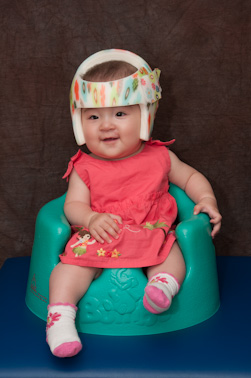
If your child has a cranial asymmetry and a treatment/prevention plan has not started before 3 months of age, a corrective helmet like the Boston Band may be prescribed.
Numerous studies demonstrate the effectiveness of cranial remolding orthosis (CRO) orthotic helmeting for the treatment of deformational plagiocephaly. An orthotic helmet acts as a mold for the infant’s head, restricting further asymmetric growth and guiding the flattened areas to grow into the empty space of the helmet in a normal, rounded fashion.
What is the The Boston Band?
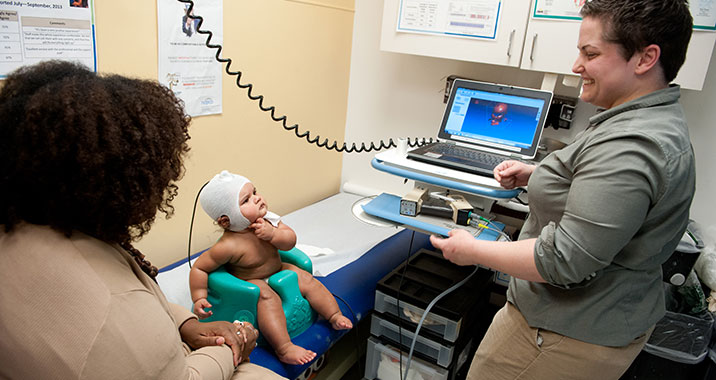
The Boston Band is a lightweight head covering made of plastic and foam that is custom-made for your child’s head using a cast impression or a 3D cranial scan. It can be equipped with our trademark hinge, which allows you to easily put it on and take it off your child.
How Does the Boston Band Work?
The Boston Band allows the baby to comfortably sleep while keeping pressure off the flat spots so the baby’s head becomes more symmetrical. The foam can be modified over time to allow for growth and will provide a pathway for the infant’s head to grow into a more symmetrical shape. It does not exert pressure on the skull and will not cause your child any pain.
How Long Does Treatment Take?
For optimum results, the Boston Band should be worn 23 hours a day, and can be removed for bathing. For children who begin wearing the Boston Band at 3-6 months of age, the problem is usually corrected within 10-14 weeks, compared to the industry standard of 4-6 months. Individual treatment plans may vary.
Boston Band Treatment Timeline
- First visit: Initial appointment and 3D scan for fabrication
- Week 2: Initial fitting and delivery of Boston Band
- Weeks 4-8: Follow up appointment/fit reassessment with orthotist
- Weeks 10+: Final appointment and final scan with orthotist
- If treatment continues past 10 weeks, follow up appointments will take place every 2-4 weeks until termination of the treatment. The final scan will take place during the final appointment.
- Appointment schedules may vary depending on the infants age and severity at the start of treatment.